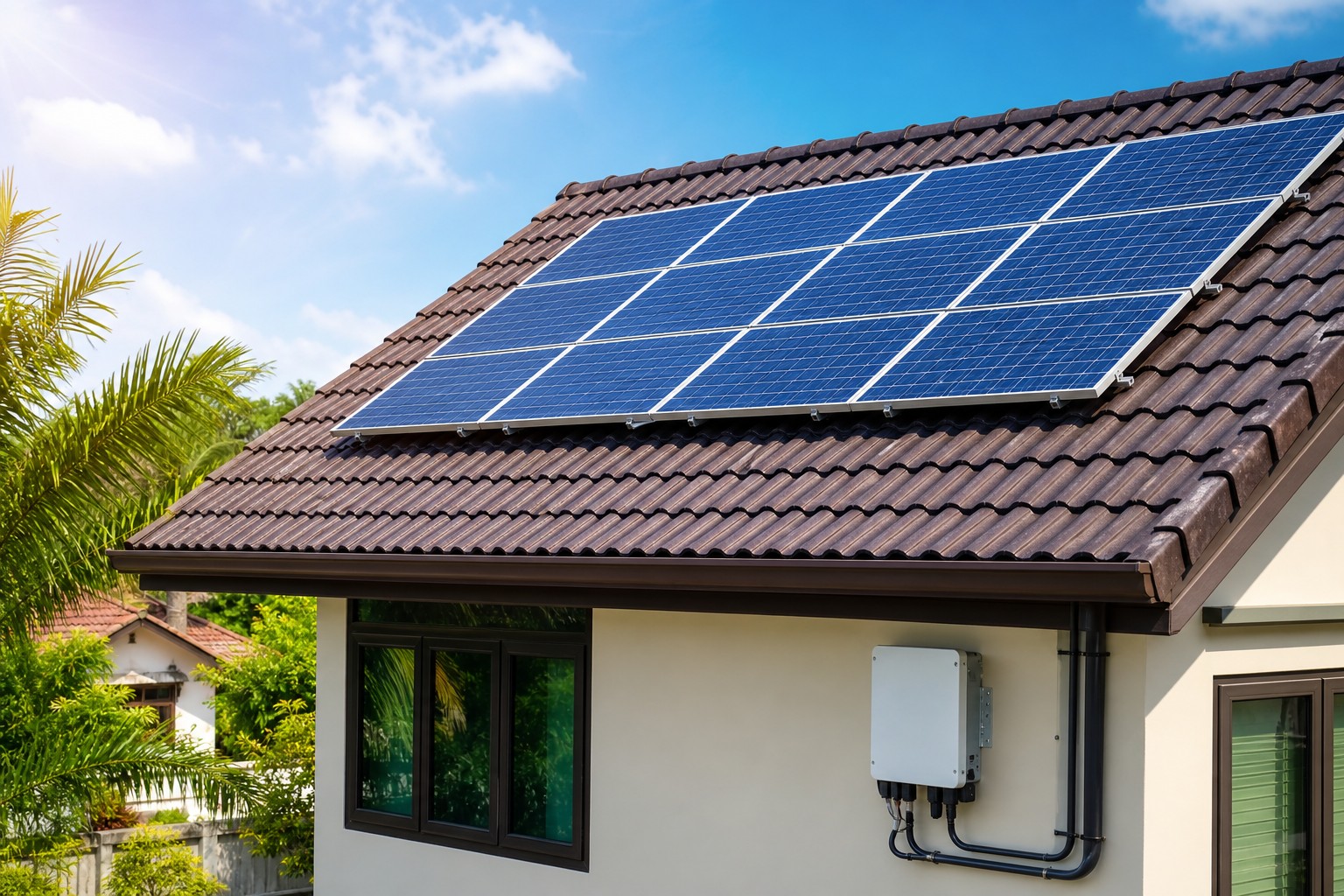
Most people know the basic idea. Panels sit on your roof, they soak up the sun, and somehow your electricity bill goes down. But when you are about to spend real money on a system, that fuzzy picture is not quite enough. You want to know what is actually happening up there and why it lowers your bill. The good news is that solar is far simpler than it looks. There are only a handful of parts, and once you see how they connect, the whole thing makes sense. Here is the plain-English version, no engineering degree required.
It starts with sunlight and silicon
A solar panel is really just a sheet of special material, mostly silicon, sealed under glass. When sunlight lands on that material, it knocks tiny particles called electrons loose, and moving electrons are exactly what electricity is. So a panel sitting in the sun is quietly producing a flow of electric current all day long, with no moving parts and no noise. String a number of these panels together on your roof and you have a small power station making electricity for your home whenever the sun is up.
One important detail is that panels respond to daylight, not just direct sunshine. That is why they keep generating on cloudy days too, just at a lower level. We go into that in our article on whether solar works on cloudy or rainy days.
The inverter does the translating
Here is the catch. The electricity a panel produces is direct current, or DC, but everything in your home runs on alternating current, or AC. They are not directly compatible, so the raw power from the panels cannot be used as it is. This is where the inverter comes in, and it is the brain of the whole system. The inverter takes the DC power coming down from your roof and converts it into the AC power your fridge, air conditioner and lights actually use.
The inverter does more than just convert, though. It manages the flow of energy, keeps everything running safely, and feeds the data that lets you watch your generation on an app. Because it works hard every day, the inverter is usually the part that gets replaced first over a system's life, typically after ten to fifteen years, while the panels themselves keep going for far longer.
Your home uses it first
Once the inverter has done its job, that clean AC electricity flows straight into your home's normal wiring. From that point it behaves exactly like power from the grid. Your appliances simply draw on the solar electricity first, without you having to do anything or flick any switches. On a sunny afternoon, if your panels are making more than enough, your home runs almost entirely on free solar power while the sun is out. That is where the savings come from. Every unit you make and use yourself is a unit you are not buying from TNB.
What happens to the extra?
During the middle of the day, a well sized system often produces more than the household is using, especially if everyone is out at work or school. That surplus does not go to waste. It flows back out to the grid, and under Solar ATAP you receive credit for the energy you export. Those credits then help offset the electricity you pull from the grid at night, when the panels are resting. So the grid acts a bit like a giant battery for your daytime surplus, balancing out your generation across the day.
If you want true independence during a blackout, that needs an actual battery rather than the grid, which we explain in our piece on what happens during a power outage. You can also read more about home storage on our battery storage page.
Putting it all together
So the full journey is short and simple. Sunlight hits the panels and creates DC electricity. The inverter converts it to usable AC power. Your home draws on that power first, and any surplus is exported to the grid for credit. At night you draw from the grid as normal, offset by the credits you built up during the day. That is the entire system, working quietly on your roof to shrink your bill for the next 25 years or more.
The only part that really needs care is designing it correctly for your home, which is about matching the number of panels to your actual usage. Our guide on what size solar system you need covers that, and when you are ready, a free site visit turns all of this theory into a concrete plan for your roof.