When you start reading about solar, you quickly bump into terms like on-grid, off-grid and hybrid, and it is not always obvious which one you actually want. They are not just technical labels. They describe fundamentally different ways of setting up your system, and the right choice depends on where you live and what you want solar to do for you. Let us walk through all three in plain terms so you can see which fits your home, and why one of them suits the vast majority of Malaysian households.
Grid-connected solar: the standard choice
A grid-connected system, also called on-grid or grid-tied, is by far the most common setup in Malaysia, and for good reason. Your panels work alongside the TNB grid rather than replacing it. During the day your home runs on solar, and any surplus is exported to the grid for credit under Solar ATAP. At night, or whenever your panels are not producing enough, you simply draw from the grid as normal, offset by the credits you built up.
The big advantage is value. Because it leans on the grid as a backup and a credit bank, a grid-connected system does not need expensive batteries, so it delivers the strongest savings for the lowest upfront cost. The one thing to know is that a purely grid-connected system shuts down during a blackout for safety, which we explain in our article on what happens during a power outage. For most homes, where outages are rare and short, that trade-off is well worth the lower price.
Off-grid solar: fully independent
An off-grid system is exactly what it sounds like. It has no connection to TNB at all. Your home runs entirely on solar power stored in a large bank of batteries, and when those batteries run low, there is no grid to fall back on. This means an off-grid setup needs a lot of battery capacity and careful sizing to get a household through cloudy spells and the night, which makes it considerably more expensive.
Off-grid genuinely makes sense in one situation, which is a property that has no practical access to the grid in the first place, such as a remote farm, an island chalet or a rural plot far from any TNB line. For a normal home in a town or city that already has a grid connection, going fully off-grid is usually overkill. You would be paying a premium to disconnect from a perfectly useful grid that could otherwise serve as free backup and a credit bank.
Hybrid solar: the best of both
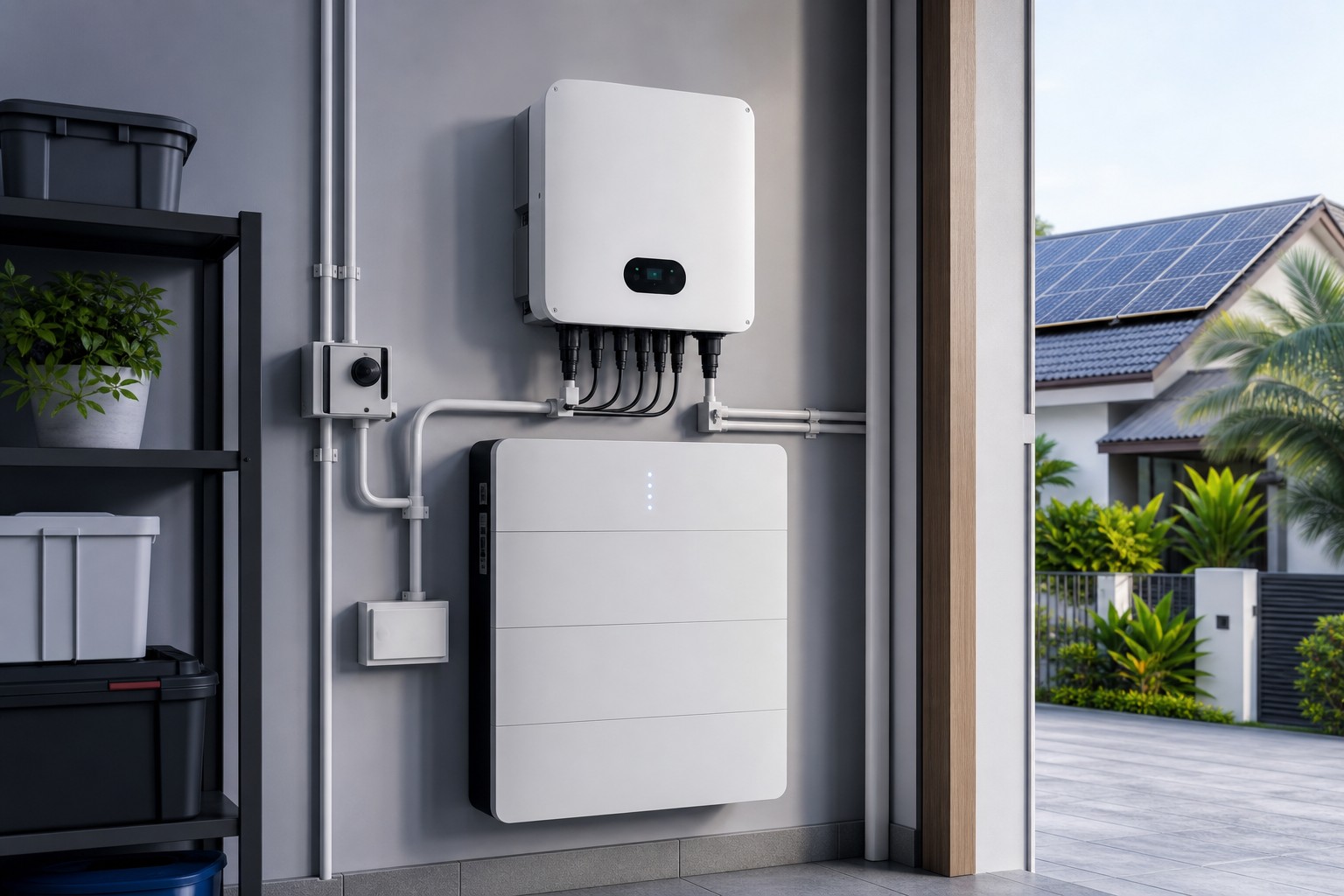
A hybrid system sits neatly between the two. It stays connected to the grid, so you keep the savings and export credits of a grid-tied setup, but it also includes a battery. That battery stores some of your daytime solar for use in the evening and, crucially, can keep your essential circuits running when the grid goes down. So you get the everyday value of on-grid solar plus genuine backup during a blackout.
Our battery storage solution is a hybrid setup of exactly this kind. It suits homes that want peace of mind during outages, or that have equipment they cannot afford to lose power to, without giving up the strong economics of staying grid-connected. It costs more than a plain grid-tied system because of the battery, so it is a considered upgrade rather than a default.
So which one should you choose?
For the overwhelming majority of Malaysian homes, a grid-connected system is the sensible starting point, because it gives the best return for the lowest cost while the grid quietly handles your nights and your backup. If reliable power through blackouts matters to you, a hybrid system is the natural step up, adding a battery to a grid-connected base. And off-grid is really reserved for properties that have no grid to connect to at all.
The right answer always comes down to your location, your budget and how much backup you value, which is exactly what we work through during a free site visit. We will look at your outage history and your priorities, then recommend the setup that genuinely fits rather than the most expensive one. If you would like to understand the sizing side too, our guide on what size solar system you need is a good companion read.