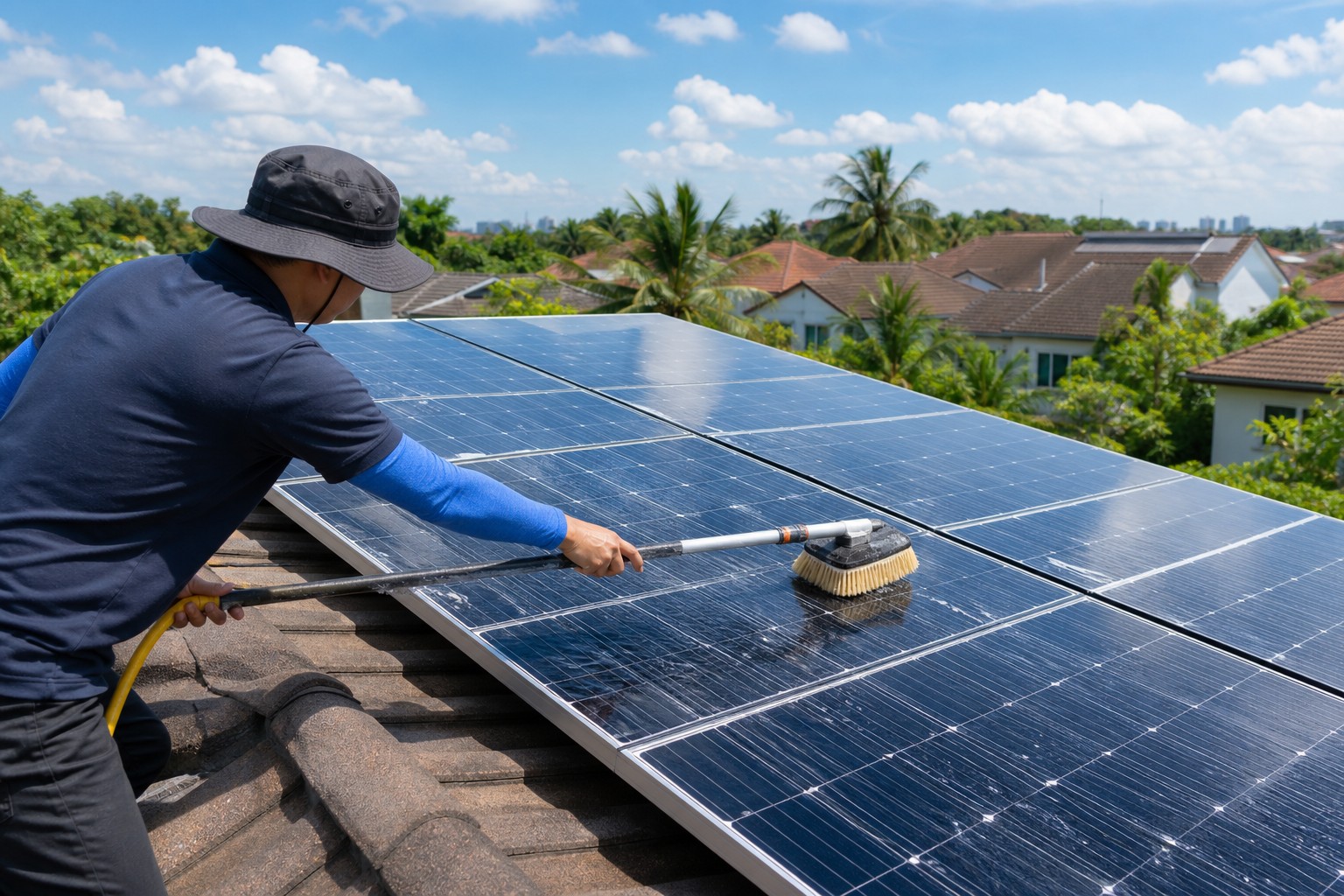
One of the first questions we hear from Malaysian homeowners is a simple one. Once the panels are on the roof, do you actually have to do anything? The honest answer is that a rooftop solar system is low maintenance, but it is not completely hands-off. The good news is that the small amount of care it does need is easy, cheap, and mostly handled for you. Here is what really happens after your system is switched on, and how much attention it needs over its 25 year life.
Why solar needs so little upkeep
A solar panel has no moving parts. It is a sealed sheet of glass and silicon that sits still and quietly turns sunlight into electricity. There is no engine, no fluid to top up, and nothing that wears out from daily use the way a car or an air conditioner does. That is the main reason a good quality system can run for decades with only occasional attention. The panels we install are Tier 1 Trina modules paired with reliable inverters, and they are built to keep performing through Malaysia's heat, humidity and heavy rain.
So when people say solar is maintenance-free, they are almost right. A more accurate way to put it is that solar asks very little of you, and most of that little bit can be done in an afternoon once or twice a year.
Cleaning the panels
Malaysia has one natural advantage here. Our frequent rain does a decent job of rinsing dust and dirt off tilted panels on its own. For many homes, that rain is enough to keep generation healthy for most of the year. Even so, a gentle manual clean every six to twelve months helps the panels work at their best, because a thin film of dust or bird droppings can quietly shave a few percent off your output.
Some homes need a little more attention than others. If you live near a highway, a construction site, a palm oil mill, or close to the coast where salty air carries more grime, panels tend to collect dirt faster. In those areas a clean every few months keeps things running smoothly. Cleaning itself is not complicated. It is soft water and a soft brush or cloth, never harsh chemicals or high pressure jets that could damage the surface.
Keeping an eye on the app
Modern systems come with a monitoring app tied to the inverter, whether that is Huawei, Solis or GoodWe. This is the single most useful maintenance habit, and it takes seconds. You open the app now and then and check that your daily and weekly generation looks normal for the weather. If a panel string or the inverter ever has a problem, the numbers dip or an alert appears, so you catch it early instead of months later. If you want to understand how monitoring fits into a wider setup, our guide to battery storage and energy management explains how the app tracks every unit you generate and use.
The inverter is the part to watch
If anything in a solar system is going to need replacing during its lifetime, it is usually the inverter, which is the box that converts the panels' DC power into the AC power your home uses. Inverters typically last somewhere in the range of ten to fifteen years, which is shorter than the panels themselves. That is normal and expected, and most inverters come with a manufacturer warranty that covers this period. A quick visual check once a year, making sure it is free of dust and its indicator lights look healthy, is all the routine attention it needs.
Do you need to hire a technician?
For everyday running, no. You do not need a full-time technician or a standing service contract to own solar. What matters far more is choosing an installer who stays around after the sale. A good company gives you a hotline for troubleshooting, can run remote diagnostics on your inverter, and will send someone out if a problem cannot be sorted remotely. In practice the large majority of issues are solved over the phone or through the monitoring platform without anyone climbing onto your roof.
Your warranty is your safety net here. A proper installation is covered on three fronts, the panels, the inverter, and the workmanship of the install itself. That means if a covered component fails within its warranty window, the fix is not an out of pocket surprise. This is exactly why we handle the full process end to end and stay on call afterward, which you can read more about in what to expect during your installation.
So, is it worth worrying about?
Not really, and that is the point. Compared with almost any other big purchase for your home, solar is remarkably quiet in the background. You clean the panels once or twice a year, glance at an app now and then, keep half an eye on the inverter, and let the warranty and your installer handle anything bigger. For that small effort you get decades of lower electricity bills and the chance to claim the SuRIA Home rebate of up to RM3,000 when you install under Solar ATAP. If you want a clearer picture of the savings and the ongoing support, the easiest next step is to talk to us directly.